
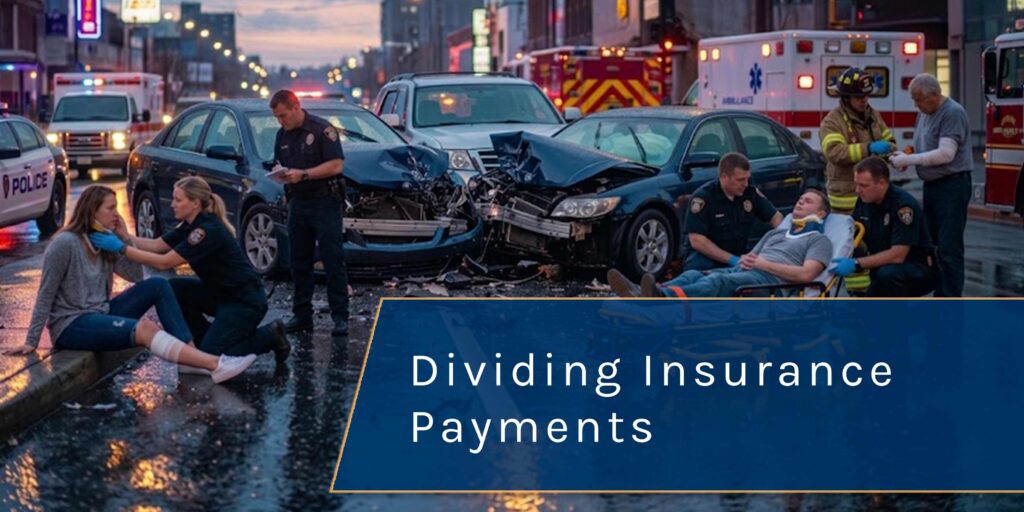
When several people are injured in the same accident, the insurance claim can become much more complicated than a typical single-victim case. Multiple injured people may be seeking compensation from the same bodily injury liability policy, and the available coverage may not be enough to fully compensate everyone. In those situations, insurance payments for injured people can depend on policy limits, the severity of each claim, the strength of the supporting evidence, and how the competing claims are resolved.
Consider a crash involving three passengers injured by the same distracted driver. One may suffer a broken wrist, another a herniated disc, and another a concussion with lasting symptoms. Even though their injuries and losses are very different, all three may be making claims against the same insurance coverage. If the total value of those claims exceeds the policy limits, the amount each person can recover may be significantly affected. An experienced Florida personal injury lawyer can help protect your claim, document its full value, and identify every source of coverage that may apply.
Table of Contents
Bodily Injury Liability: How Multiple Injury Claims Are Paid
PIP is Florida’s no-fault coverage that pays certain medical expenses and lost wages after an accident, regardless of who caused the crash, but its limited benefits are rarely enough in a serious injury case.
After PIP, most multi-claimant disputes focus on the at-fault driver’s bodily injury (BI) liability coverage. BI coverage pays people injured because of the insured driver’s negligence, so it often becomes the primary source of insurance payments for injured people when several claims arise from the same accident.
Most BI policies use split limits, often written as $50,000/$100,000. The first number is the maximum available to one injured person, while the second is the maximum available for everyone injured in the same accident.
Per-Person Limits Cap Individual Claims
A per-person limit is the most one injured person can recover from the bodily injury policy, even if the claim is worth much more.
For example, if a victim has $120,000 in damages but the policy has a $50,000 per-person limit, the insurer cannot pay more than $50,000 under that coverage. Strong documentation becomes especially important when several people are competing for limited coverage.
Per-Accident Limits Cap the Total Available
A per-accident limit controls how much the insurer can pay for all injury claims combined.
If three valid claims total $250,000 but the policy has a $100,000 per-accident limit, only $100,000 is available from that policy. When the combined claims exceed the per-accident limit, the available coverage may have to be divided among the injured claimants based on how the competing claims are resolved.
How Insurers Determine Insurance Payments for Injured People
Insurance adjusters evaluate each claim based on risk, damages, and supporting evidence. As a result, two people injured in the same crash can receive very different offers.
Common factors include:
- Injury severity and permanence
- Type and length of treatment
- Objective findings, such as MRI or CT results
- Lost wages and reduced earning capacity
- Prior medical history and causation issues
- Consistency of treatment
Strong documentation can significantly affect insurance payments for injured people. Medical records, imaging, specialist evaluations, and consistent follow-up help establish the value of a claim, while gaps in treatment can give insurers reasons to reduce an offer.
Insurers may also consider whether a claimant is represented and how strongly the claim is presented. An early settlement with one claimant can also reduce the amount of coverage remaining for others.
How UM/UIM Coverage Can Affect Available Compensation
When the at-fault driver has no bodily injury coverage or does not have enough to cover your losses, your own uninsured/underinsured motorist coverage may provide another source of compensation.
- UM coverage may apply when the at-fault driver has no applicable bodily injury coverage.
- UIM coverage may apply when the at-fault driver’s liability limits are not enough to cover your damages.
Generally, you pursue the available liability coverage first, then seek additional compensation through UM/UIM coverage, subject to your policy limits and terms.
Florida policies may also provide stacking or non-stacking UM coverage. Stacking can increase the amount of available coverage by combining applicable limits, while non-stacking coverage generally provides lower limits. The specific policy language determines what coverage is available.
Passengers and Household Members: How Coverage Layers Affect Compensation
Passengers often assume the driver’s insurance will handle everything. That is rarely true. Passengers typically claim against the at-fault driver first. However, they may also have their own PIP and UM/UIM options. So, insurance payments for injured people can depend on what coverage applies to each person, not simply where they were sitting.
A common layered path looks like this. A passenger may:
- Use their own PIP for initial medical bills and wage loss.
- Pursue the at-fault driver’s BI policy for the injury claim.
- Use their own UM/UIM if BI limits are too low or nonexistent.
Also, fault may not rest with one driver. Multi-vehicle crashes can open more than one liability policy. That matters because multiple policies may provide additional sources of compensation instead of leaving every injured person dependent on one low-limit policy. Even so, insurers still fight over percentages of fault and the order of payment.
Common Mistakes That Can Reduce Compensation in Multi-Injury Claims
When several people are injured in the same crash, limited coverage can make every part of the claim more important. Common mistakes include:
- Delaying medical care: Insurers may argue that your injuries were minor or unrelated to the crash.
- Having gaps in treatment: Inconsistent care can make it harder to prove that ongoing symptoms were caused by the accident.
- Giving a recorded statement too early: What you say may later be used to challenge your injuries or reduce the value of your claim.
- Accepting a quick settlement: Signing a release can prevent you from seeking more compensation if your injuries worsen or require additional treatment.
- Relying on PIP alone: Florida PIP provides limited benefits and is rarely enough in a serious injury case.
When multiple claimants are competing for limited policy limits, having an experienced Florida personal injury lawyer can be especially important. A Florida car accident attorney can document the full value of your injuries, identify all available insurance coverage, handle communications and negotiations with the insurers, and protect your position while other claims are being resolved.
Why a Florida Lawyer Matters in a Multi-Claimant Injury Case
When several people are competing for limited insurance coverage, timing, documentation, and negotiation can directly affect the outcome.
A Florida personal injury lawyer can help by:
- Gathering medical records, wage-loss proof, and other evidence that supports the full value of your claim
- Identifying all available insurance coverage, including possible UM/UIM coverage
- Preparing a strong demand and responding to attempts to undervalue the claim
- Addressing liens and medical bills that may affect the final recovery
- Monitoring settlement timing when other injured people are also making claims
In a multi-claimant accident, settling too quickly can mean accepting less than the claim is worth, while waiting too long can create other risks. An experienced Florida personal injury lawyer can protect your position and pursue the compensation available under all applicable policies.
FAQs (Frequently Asked Questions)
Why Do Insurance Payments Get Complicated in Florida Multi-Injury Crashes?
Several injured people may make claims against the same bodily injury liability policy after a Florida crash. If the coverage is limited, the policy may not fully compensate everyone. Each person’s injuries, damages, and supporting evidence can affect the outcome.
How Do Split Limits Affect Florida Injury Claims?
Bodily injury policies often use split limits, such as $50,000 per person and $100,000 per accident. The per-person limit caps one person’s recovery. The per-accident limit caps the total amount available for everyone injured in the crash. These limits can directly affect insurance payments for injured people.
How Do Per-Accident Limits Affect Multiple Claims?
Per-accident limits cap what the insurer can pay for all bodily injury claims from one crash. If the combined claims exceed that amount, several injured people may have to share limited coverage. The insurer does not have to divide the available funds equally.
How Do Florida Insurers Value Multiple Injury Claims?
Insurers review the severity of each injury, the treatment involved, and the medical evidence. They also consider lost wages, prior medical history, and consistency of care. Strong documentation can help support the value of insurance payments for injured people when several claims compete for limited coverage.
How Can UM/UIM Coverage Help in Florida?
UM/UIM coverage can provide another source of compensation when the at-fault driver has little or no bodily injury coverage. An injured person may pursue additional compensation through their own policy, depending on the coverage terms and limits.
Protect Your Claim When Multiple People Are Injured
When several people are seeking compensation from the same insurance policy, limited coverage can make the claims process more complicated. Medical evidence, damages, timing, and access to additional coverage can all affect how much compensation you may recover.
At Personal Injury Attorneys McQuaid & Douglas, our trusted team can investigate every available source of insurance coverage, gather the medical and financial evidence needed to show the full value of your claim, and deal directly with the insurance companies when multiple injured people are competing for limited policy limits. Our attorneys can also evaluate whether additional coverage, including UM/UIM benefits, may be available and work to protect your claim before other settlements affect the remaining coverage.
If you or a loved one has been injured in an accident involving multiple victims, contact us today for a free consultation. We can review the available coverage, explain your options, and help you pursue the compensation you deserve.