
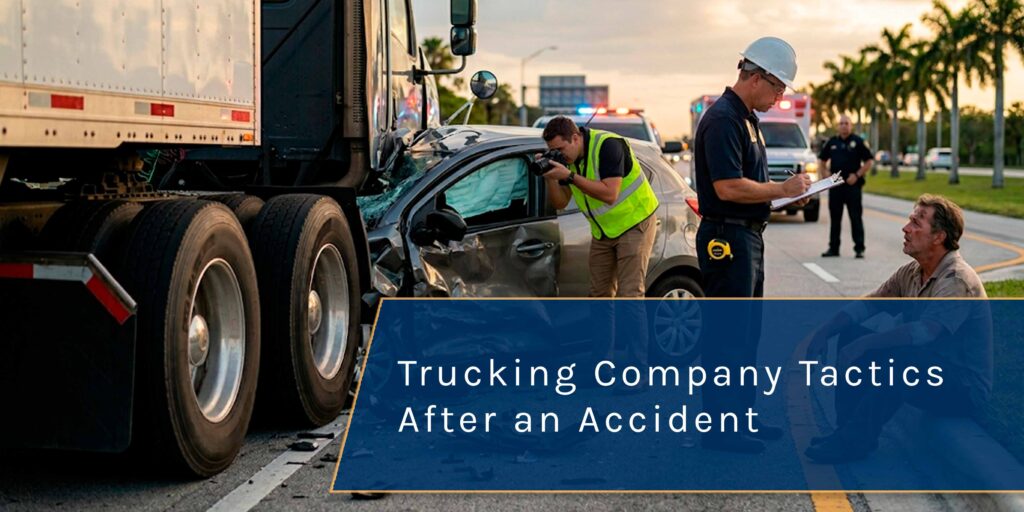
After Florida truck accidents, trucking companies and their insurers often activate a rapid response strategy designed to protect their bottom line, not your recovery. While injured drivers focus on medical care and vehicle damage, commercial carriers are already preserving evidence, interviewing witnesses, and consulting defense counsel. They understand exactly how high-stakes truck accident claims unfold. Most crash victims do not.
Imagine you are traveling on I-275 near Tampa when a tractor trailer suddenly sideswipes your vehicle. The collision happens in seconds. The legal and financial consequences, however, begin immediately, and the steps taken in the hours that follow can significantly impact the strength and value of your claim.
Here is the reality. You may still be shaken, in pain, or waiting for diagnostic tests. At the same time, the trucking company may already be assembling a defense file, reviewing driver logs, and preparing statements intended to limit liability. In serious Florida truck accidents, the investigation often starts long before victims realize they need one of their own.
Table of Contents
Why Florida Truck Accidents Are Different From Regular Car Crashes
Florida truck accidents rarely involve just two drivers and one insurance policy. Instead, liability can run through multiple layers, including:
- The truck driver
- The trucking company
- The owner of the tractor or trailer
- Cargo loaders or shippers
- Freight brokers
- Third-party maintenance providers
That chain matters because each link may hold insurance coverage and legal responsibility. At the same time, it creates confusion by design; more players mean more finger pointing.
Regulation also complicates Florida truck accidents. Your claim may involve Florida statutes, federal safety rules under the FMCSA, and Florida Highway Safety and Motor Vehicles reporting requirements. Because these rules overlap, evidence must match both state and federal standards. This regulatory complexity is one reason it is critical to have a Florida truck accident lawyer who understands how to secure, analyze, and preserve the specific records needed to prove liability under both systems.
At the same time, trucking companies are not waiting for these issues to sort themselves out. They follow a predictable defense strategy immediately after serious crashes. Understanding the most common tactics used after Florida truck accidents can help you anticipate what may happen next.
Florida Truck Accident Tactic #1: Rapid Response Teams And Controlled Statements
After major Florida truck accidents, companies may deploy investigators and insurance adjusters quickly. Sometimes they appear at the scene. Other times they call you within days.
They often sound friendly. Still, the goal stays the same; lock you into a statement before you understand your injuries.
Common scripts include:
- “Are you okay? We just need your side for the report.”
- “This was unavoidable because traffic stopped suddenly.”
- “Sign here so we can pay your medical bills.”
Be careful. A recorded statement can turn into a tool to dispute fault or downplay injuries. Even small wording issues can hurt later, especially when symptoms worsen.
Florida Truck Accident Tactic #2: Blaming The Victim Using Comparative Negligence
Florida uses a comparative fault system. In plain terms, your recovery can drop if the insurer assigns you a percentage of blame.
For example, if damages total $500,000 and the insurer claims you were 20% at fault, they argue you should only receive $400,000. Therefore, shifting even small fault can save them big money in Florida truck accidents.
Common blame themes include:
- “You made an unsafe lane change.”
- “You stopped too suddenly.”
- “You were speeding or following too closely.”
Because these arguments often rely on selective facts, evidence becomes critical. Vehicle data, scene measurements, and witness accounts can defeat unfair fault claims.
Florida Truck Accident Tactic #3: Denying The Employment Relationship
Another common defense in Florida truck accidents involves classification. The company may claim the driver was an independent contractor, not an employee.
They use that framing to dodge vicarious liability. They want to argue, “The driver acted alone, so do not blame us.”
Misclassification happens. Courts look at the real relationship, not just a label in a contract. Control over routes, schedules, equipment, and policies can matter. If the company directed the work, it may still face liability.
Florida Truck Accident Tactic #4: Shifting Fault To Third Parties
Trucking defendants often try to spread blame. They may point to cargo loading companies, brokers, or maintenance contractors.
This tactic can succeed for one reason. Multiple defendants can create delay and confusion, especially in Florida truck accidents with severe injuries.
Common targets include:
- Cargo loaders accused of improper loading or securement
- Brokers blamed for negligent carrier selection
- Repair shops blamed for faulty brakes or missed defects
Sometimes third parties truly share fault. However, companies also use this approach to dilute responsibility and complicate settlement talks. A focused investigation keeps the case from drifting.
Florida Truck Accident Tactic #5: Hiding, Destroying, Or “Losing” Critical Evidence
Evidence can disappear fast after Florida truck accidents. Some data overwrites in days or weeks. Meanwhile, vehicles get repaired and documents “go missing.”
Risks include:
- Tampering with paper logbooks
- Deleting electronic data from trucks
- Repairing the truck before inspection
- Losing driver qualification or training files
You cannot assume the company will preserve what hurts them. That is why Florida truck accident attorneys often send a spoliation letter quickly. It puts the company on notice to preserve key evidence.
Florida Truck Accident Evidence You Need for Your Case
Winning Florida truck accidents often comes down to records and data, not opinions. Key evidence may include:
- Electronic logging devices (ELDs) and logbooks: These can show hours-of-service compliance, fatigue risk, and route pressure.
- Black box or ECM data: This can show speed, braking, throttle, and sometimes collision events.
- Maintenance logs and inspection records: These can reveal skipped inspections, worn brakes, tire problems, and repeated defects.
- Bills of lading and cargo documents: These can show load weight, loading parties, and whether the cargo shifted.
- Driver training and qualification files: These can show prior crashes, medical issues, licensing problems, and inadequate training.
Each category can prove negligence. For example, braking data can contradict a “sudden stop” story. Likewise, maintenance files can expose long-term safety neglect. Your Florida truck accident lawyer will use this evidence to obtain the best possible settlement from the insurer.
Florida Truck Accident Causes That Companies Try To Downplay
Many Florida truck accidents involve predictable root causes. Yet companies often minimize these issues because they point to systemic failures.
Common causes include:
- Driver fatigue and deadline pressure: Long shifts and tight dispatch schedules can push unsafe decisions.
- Distracted driving: Phone use, onboard devices, and navigation changes can steal attention.
- Intoxication or drug impairment: Even prescription misuse can impair reaction time.
- Drowsy driving: Micro-sleeps can happen without warning, especially on overnight runs.
Operational failures also matter in Florida truck accidents:
- Poor driver supervision
- Unsafe dispatch practices
- Inadequate hiring or screening
- Neglected maintenance and delayed repairs
Federal enforcement data often highlights hours-of-service issues. For example, FMCSA cited hours-of-service violations in a significant share of driver inspections in 2020. That pattern supports what victims already suspect; fatigue remains a major safety problem.
Compensation Explained After Your Accident
Compensation in Florida truck accidents should reflect the full cost of your injury, not just the first hospital bill. Serious truck crashes often require long-term care. That means your claim needs a forward-looking plan.
Economic damages may include:
- Emergency care, hospitalization, and surgery
- Follow-up visits, imaging, and prescriptions
- Rehab, physical therapy, and assistive devices
- Future medical care and projected treatment costs
Wage-related losses can also drive case value in Florida truck accidents, including:
- Lost income while you recover
- Reduced earning capacity if you cannot return to the same work
- Lost benefits and job opportunities tied to your career path
Non-economic damages often matter just as much:
- Pain and suffering
- Emotional distress
- Loss of enjoyment of life
- Permanent disability impacts
The sooner you speak with a Florida truck accident lawyer, the better protected your claim may be. Early legal guidance can help prevent costly mistakes, preserve critical evidence, and keep trucking companies and insurers from controlling the narrative. If you were injured in a truck crash, make sure you have experienced representation on your side from the very beginning.
FAQs (Frequently Asked Questions)
How are Florida truck accidents different from regular car crashes?
Florida truck accidents often involve multiple parties beyond the drivers, including the trucking company, vehicle owner, cargo loaders, brokers, and maintenance providers. This layered liability, combined with overlapping state and federal regulations, makes these claims far more complex than typical car crashes.
What tactics do trucking companies use to limit liability?
Trucking companies often deploy rapid response teams, push comparative negligence claims, deny employment relationships, shift blame to third parties, and attempt to limit or control critical evidence.
Why is it risky to give a recorded statement soon after your crash?
Giving a recorded statement too soon can be risky because your injuries might not be fully apparent yet. Insurers may use your words to downplay fault or injury severity. Even minor wording issues can later harm your case when symptoms worsen or more facts emerge.
How does comparative negligence affect settlements in Florida accident cases?
Florida follows a comparative fault system, meaning your compensation decreases by your percentage of blame. If you are 20 percent at fault for $500,000 in damages, your recovery drops to $400,000. Trucking companies often try to shift fault onto you to reduce what they pay.
What kinds of evidence are crucial in proving fault in Florida truck accidents?
Critical evidence includes vehicle data recordings, scene measurements, witness statements, driver qualification files, maintenance records, and compliance with safety regulations. Promptly preserving this evidence is key because data can be lost or destroyed quickly after an accident.
Injured in a Florida Truck Accident? Contact Us Today to Protect Your Rights
After Florida truck accidents, trucking companies move quickly to protect themselves. You deserve someone moving just as quickly to protect you.
At Personal Injury Attorneys McQuaid & Douglas, we can help you get clear answers about your rights, your options, and the true value of your claim. An experienced Florida truck accident lawyer can review the crash, identify all potentially liable parties, and take immediate steps to preserve critical evidence such as ELD data, black box information, driver qualification files, and maintenance records.
The sooner you act, the stronger your position may be. Evidence can disappear, memories fade, and early statements can affect your case. If you were injured in a truck crash, schedule a free consultation today and find out how to protect your claim from the start.