
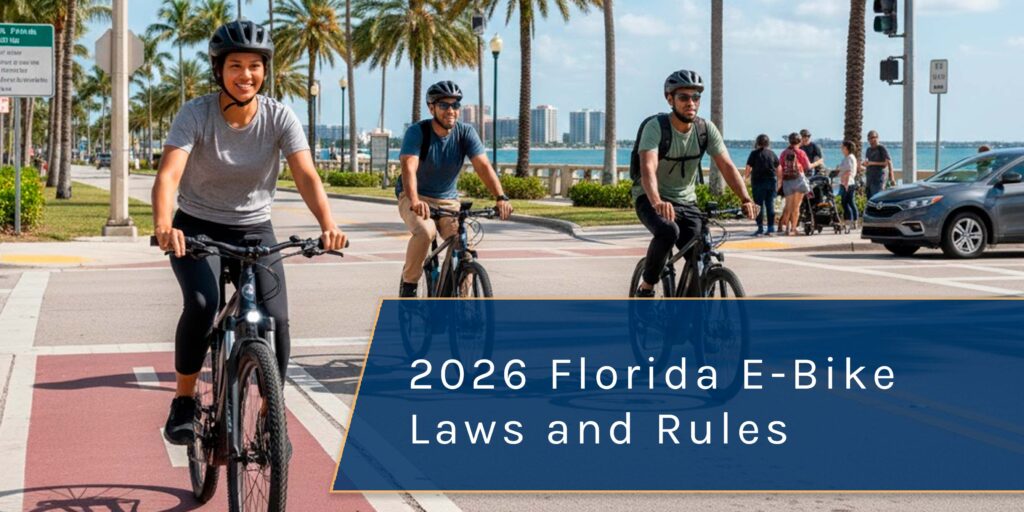
2026 e-bike rules in Florida are increasingly important as the state’s micromobility traffic grows. E-bikes, electric scooters, and other small electric vehicles now share roads, trails, and sidewalks with cars, pedestrians, and traditional bicycles. This rise in shared traffic has led lawmakers to clarify safety standards, improve classifications, and provide better enforcement tools.
Under Florida’s e-bike law (HB 971, Florida Statutes Chapter 316), riders need to understand their bike’s class because it determines where you can ride, what safety equipment is required, and whether your e-bike is treated as a bicycle or a motor vehicle. That distinction matters not just for daily riding, but also in the event of a crash, making awareness of the 2026 rules essential for every rider.
Table of Contents
Florida E-Bike Classifications Explained
2026 e-bike rules in Florida follow a three-class system that is aligned with national standards. The classification comes down to two main questions: Does the motor assist only when you pedal, or can you use a throttle? And at what speed does the motor stop assisting?
Here are the core classes riders need to know:
- Class 1 E-Bikes: Pedal assist only; motor assistance stops at 20 mph.
- Class 2 E-Bikes: Throttle capable; motor assistance stops at 20 mph.
- Class 3 E-Bikes: Pedal assist only; motor assistance stops at 28 mph.
Classifications affect where you can ride. Many agencies allow Class 1 and 2 bikes on shared paths and multi-use trails, while Class 3 often faces restrictions on sidewalks, certain bike lanes, and crowded trails.
Riding Safely Under 2026 E-Bike Rules in Florida
Riders should watch for common challenges:
- High-speed e-bikes that exceed Class 3 limits.
- Modified e-bikes that may lose bicycle status.
- Devices over legal limits that may be treated as mopeds or electric motorcycles, requiring licensing, registration, or additional equipment.
Class 1 bikes are ideal for recreational riding and most shared paths, while Class 2 bikes allow throttle operation, though some trails and sidewalks may restrict their use. Class 3 e-bikes offer pedal assist up to 28 mph, which can make commuting in traffic safer, but many local agencies limit Class 3 access to reduce conflicts with pedestrians.
Understanding 2026 e-bike rules in Florida ensures riders stay safe, legal, and confident wherever they ride. Always check local signage and ordinances before hitting the road or trail.
Speed Limits and Motor Power Requirements
Most 2026 e-bike rules in Florida focus on two key technical limits: assisted speed and motor power. These limits determine whether a bike qualifies as an e-bike or is treated more like a motor vehicle.
Riders often search for terms like “motor under 750 watts” because that threshold is crucial. In Florida, e-bikes must have fully operable pedals and an electric motor of less than 750 watts, with motor assistance capped according to the bike’s class. Class 1 and 2 bikes are limited to 20 mph, while Class 3 can go up to 28 mph on pedal assist only.
Exceeding these limits can create issues quickly. A bike with a higher-powered motor or one capable of speeds above Class 3 may no longer meet the e-bike definition. In that case, it could be treated like a moped or electric motorcycle, triggering additional rules for equipment, licensing, and registration. Understanding these restrictions is essential for riding safely and legally under 2026 e-bike rules in Florida.
2026 E-Bike Rules: Helmet Requirements, Minimum Age, and Safe Riding
Under 2026 e-bike rules in Florida, helmet requirements depend mainly on age. Riders and passengers under 16 are legally required to wear a properly fitted helmet. Riders 16 and older are generally not mandated by state law to wear one, though it is strongly recommended for safety. Helmets remain the simplest and most effective way to reduce the risk of head injuries.
Age restrictions also matter for higher-speed e-bikes. Some rules and proposals focus on limiting Class 3 use to older riders, and local governments may impose additional minimum age or ID requirements for specific trails, roads, or public areas. As a result, riders should always check both state-level laws and city or county ordinances before allowing a teen to ride a Class 3 e-bike.
Safe operation rules are just as important as equipment. Always ride with the flow of traffic on the road, and use lights and reflectors at night. Yield and slow down on crowded sidewalks, trails, or multi-use paths, even if e-bikes are technically permitted. Following these precautions helps reduce accidents, protect pedestrians, and ensures compliance with 2026 e-bike rules in Florida.
Where You Can Ride in Florida: Roads, Bike Lanes, Sidewalks, and Trails
Florida generally treats qualifying e-bikes like bicycles, which provides a helpful starting point. However, access still depends on two key factors: your e-bike’s class and local government regulations. Cities, counties, and other managing agencies can add rules that affect where, how, and when you can ride, so understanding both state and local requirements is important.
Here is how the main riding zones usually work:
- Roadways: E-bike riders generally follow the same rights and duties as traditional cyclists, including obeying traffic controls.
- Bicycle lanes: Typically allowed for all classes, though some local rules may restrict Class 3 e-bikes in busy downtown areas or near pedestrian-heavy zones.
- Sidewalks: Often permitted, but riders must operate at pedestrian-level speeds and yield to foot traffic. Local governments can restrict or prohibit e-bikes on sidewalks in some areas.
- Multi-use trails and paths: Usually allowed for Class 1 and Class 2, though Class 3 may face restrictions. Access is subject to agency rules and posted signage. For example, some sections of the Pinellas Trail may limit motorized vehicles, and Hillsborough County parks often restrict speeds or certain e-bike classes on multi-use paths.
By understanding your e-bike class, checking local ordinances, and observing posted rules on trails or parks, you can ride safely and legally in Florida.
Do E-Bikes Require a License, Registration, or Insurance in Florida?
Most riders want clear answers to common questions, including whether a driver’s license is required, if registration or a license plate is necessary, and whether e-bikes must be insured in Florida.
For standard Class 1, Class 2, and Class 3 e-bikes that meet the legal definition, Florida generally does not require a driver’s license, registration, or license plates. Insurance also is not usually required. That said, many riders still choose coverage through homeowners, renters, umbrella policies, or specialty options, especially for higher value bikes or higher speed riding.
Classification and modifications can change everything. If you modify an e-bike to exceed legal speed limits, or you install a motor above the 750 watt threshold, you can move the bike into a motor vehicle category. At that point, registration, licensing, and insurance rules may apply.
When riders want to confirm vehicle related requirements, they often check the Florida Department of Highway Safety and Motor Vehicles (FLHSMV). That is a smart step, especially if you bought a nonstandard device or you suspect it exceeds e-bike limits.
Equipment and Labeling: What Riders Need to Know
Clear labeling and proper equipment can make a real difference if a crash occurs. Your e-bike should display its class, top assisted speed, and motor wattage, and the label should remain visible. Law enforcement or park staff rely on this information to confirm that your bike meets the legal e-bike definition.
E-bikes must also meet basic bicycle equipment standards, including working lights, reflectors, and brakes. Following these requirements not only helps you ride safely but can also prevent misclassification arguments if you’re involved in a Florida e-bike accident.
In a crash, proper labeling and equipment can affect how liability is determined. Officers, park rangers, and insurance adjusters may check the label to classify your e-bike as a bicycle or motorized vehicle. Keeping your bike compliant and clearly marked helps protect your rights and matters after an e-bike accident in Florida.
What to Do After an E-Bike Accident in Florida
Health comes first. Call 911 and get medical care right away. Do not downplay head, neck, or back symptoms, even if you feel fine at the scene.
Next, protect evidence before it disappears. Take photos of the roadway, traffic signals, and any trail signage. Photograph your bike from multiple angles, including visible damage, speed settings, display readouts, and the class label or motor information if available.
Then, gather the basics. Collect driver information, witness names, and contact details. Ask for the crash report number. If nearby businesses or homes have cameras, request that they preserve the footage.
Finally, protect your rights. Avoid admitting fault or guessing about speed. Do not give a recorded statement to an insurance company before speaking with a lawyer. An experienced e-bike accident attorney can help you understand how Florida’s 2026 e-bike rules, local ordinances, and liability laws apply to your situation and guide you on next steps.
FAQs (Frequently Asked Questions)
What are the 2026 e-bike rules in Florida and why do riders need to know them?
In 2026, Florida is updating its e-bike laws to clarify safety standards for electric bicycles, scooters, and similar devices. These changes help improve rider safety and define where different e-bike classes can be used.
How are Florida e-bikes classified in 2026?
Florida classifies e-bikes into three categories: Class 1 (pedal assist only), Class 2 (throttle capable), and Class 3 (pedal assist up to 28 mph).
What are the motor power limits and helmet requirements for e-bike riders in Florida as of 2026?
Florida limits e-bike motors to under 750 watts; exceeding this can change the device’s legal classification. Helmet rules and age restrictions vary by class and location, with minors often required to wear helmets.
After an E-Bike Crash: Your Legal Rights and Next Steps
Protecting your rights after an e-bike crash is essential. Crashes may involve driver negligence, unsafe roads or trails, poor maintenance, or defective e-bike components. Understanding Florida e-bike laws and local ordinances helps you stay informed and prepared. A knowledgeable lawyer can guide you, ensure your evidence supports your case, and help you pursue compensation. Do not handle it alone. Legal support increases your chances of receiving the settlement you deserve.
If you were injured in an e-bike crash in Florida, contact us at Personal Injury Attorneys McQuaid & Douglas for a free consultation. Have your crash report, medical records, and evidence reviewed so you understand your options clearly. You may be entitled to far more compensation than insurance initially offers. Act quickly to protect your rights and get the guidance you need after a Florida e-bike accident.