
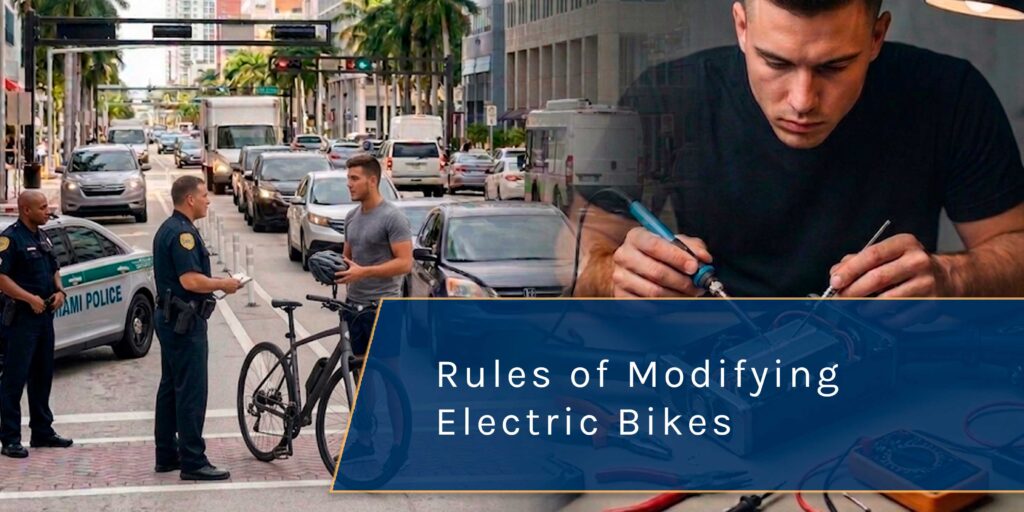
Electric bikes are easy to customize, but not every upgrade is as simple as installing a new accessory. Modifying electric bikes in Florida can affect more than performance. Depending on the changes you make, your e-bike’s legal classification, where you can ride, and even your rights after an accident may all be impacted.
Common modifications include increasing the top assisted speed, removing a factory speed limiter, upgrading the controller, installing a higher wattage motor, changing the battery or wiring, adding a throttle to a pedal assist only bike, or altering the required class label.
These upgrades may seem harmless, but some can cause your e-bike to fall outside Florida’s legal definition of an electric bicycle. If that happens, different laws may apply, and insurance companies may raise additional issues if you are involved in a crash. Understanding the rules before modifying your e-bike can help you avoid unexpected legal and financial consequences. If you are injured in an accident involving a modified e-bike, an experienced Florida personal injury lawyer can help protect your rights and explain your legal options.
Modifying Electric Bikes In Florida: Understanding Florida’s E-Bike Laws
While you may see the federal e-bike definition referenced online, Florida law determines how e-bikes are classified and where they can be ridden. Since July 1, 2020, Florida has used a three-class system for electric bikes.
Under Florida law, an e-bike is generally a bicycle or tricycle with fully operable pedals, a seat or saddle, and an electric motor of less than 750 watts.
Florida recognizes three classes:
- Class 1: Pedal assist only; motor assistance ends at 20 mph
- Class 2: Throttle capable; motor assistance ends at 20 mph
- Class 3: Pedal assist only; motor assistance ends at 28 mph
These classifications are important because modifying an e-bike can change its legal class. If your bike no longer matches its classification, different laws may apply.
The Two Numbers That Matter When Modifying Electric Bikes In Florida
Most performance modifications affect motor wattage or top assisted speed.
Florida defines an e-bike as having a motor of less than 750 watts, while top assisted speed determines whether the bike qualifies as Class 1, Class 2, or Class 3.
The key is motor-assisted speed, not how fast the bike travels downhill. Coasting above 20 or 28 mph does not change your bike’s classification. However, if the motor continues providing assistance beyond the legal speed limit for its class, your e-bike may no longer qualify for that classification.
How A Bike’s Class Can Change After Modifying An E-Bike in Florida
A bike’s legal classification can change if you modify its throttle operation, speed settings, or motor performance. Even small changes may cause the bike to no longer qualify for its labeled class, creating legal issues after a traffic stop or accident.
Class 1 Risk Points
Class 1 e-bikes use pedal assist only and stop providing motor assistance at 20 mph.
Common modifications that may affect Class 1 status include:
- Adding a throttle
- Increasing motor assistance beyond 20 mph
- Installing a controller that removes the speed cutoff
If these changes are made, the bike may no longer qualify as a Class 1 e-bike.
Class 2 Risk Points
Class 2 e-bikes allow throttle use but must stop providing motor assistance at 20 mph.
Common modifications include:
- Increasing throttle response or power
- Removing the speed limiter
- Installing a controller that allows assistance above 20 mph
These changes may prevent the bike from qualifying as a Class 2 e-bike.
Class 3 Risk Points
Class 3 e-bikes provide pedal assist only and stop assisting at 28 mph.
Increasing motor assistance beyond 28 mph can change the bike’s legal classification. If the bike is involved in a crash, insurers or other parties may argue that it no longer qualifies as an e-bike under Florida law. An experienced e-bike accident lawyer can help address these disputes and protect your right to seek compensation.
Speed Unlocks, “Off-Road” Modes, And Derestriction
“Derestricting” usually means removing the built-in speed limiter through software, hardware, or both. Sometimes it looks harmless, like an “off-road mode” in an app. In reality, it often raises the assisted speed limit.
Florida law generally requires e-bikes manufactured after January 1, 2021, to display a permanent classification label. If you modify the bike, the label should accurately reflect those changes.
Here is the core legal problem with modifying electric bikes in Florida through derestriction: the bike may no longer qualify for the class shown on its label. That can create issues with law enforcement, insurance companies, and liability after a crash.
Motor Swaps, Controller Upgrades, And Battery Changes
Power modifications often come in three forms: motor changes, controller changes, and battery changes. Each can affect wattage and assisted speed. As a result, each can affect legal classification.
Common power mods include:
- Installing a higher-watt hub motor
- Swapping from hub to mid drive
- Upgrading the controller to raise current limits
- Changing firmware or “tuning” assist curves
- Installing a higher-voltage battery pack
- Rewiring or combining packs to raise voltage
Battery capacity alone usually affects range, not classification. Battery voltage and controller output can affect top speed and motor behavior. Once you start stacking these upgrades, modifying electric bikes in Florida can push the bike outside the “less than 750 watts” framework in function, even if the original bike started compliant.
Where You Can Ride On Sidewalks, Lanes, Paths, And Roads
Florida’s e-bike statute generally treats compliant e-bikes like bicycles. That means e-bikes can operate where bicycles can operate, including bike lanes, streets, sidewalks, and multi-use paths.
Still, location rules depend on three layers:
- Your e-bike class and actual operation
- Local ordinances; counties and municipalities can regulate sidewalk and sidewalk area operation
- Property rules; parks, trails, HOAs, and private facilities can set their own restrictions
So, after modifying electric bikes in Florida, you should assume scrutiny increases. If your bike looks faster, louder, or more powerful, you can expect more complaints and more stops.
When you ride, follow predictable bicycle operation rules. Use bike lanes when practical. Yield where required. Signal turns. Keep speeds reasonable on shared paths. Those habits reduce crash risk and reduce the chance someone paints you as reckless.
Licensing, Registration, And Insurance Issues When You Go Too Far
Most compliant e-bikes in Florida do not require a driver’s license, vehicle registration, or auto insurance. However, modifying an e-bike can blur the line between an electric bicycle and another type of motorized vehicle. If your bike no longer meets Florida’s legal definition of an e-bike, insurance companies may dispute coverage or argue that different laws apply.
After a crash, identifying all available insurance coverage can be more complicated than many riders expect. Depending on the circumstances, coverage may be available through a motor vehicle insurance policy, Personal Injury Protection (PIP) benefits, homeowner’s or renter’s insurance, or other applicable policies. An experienced e-bike accident lawyer can investigate the facts, identify all potential sources of insurance coverage, and pursue every available avenue of compensation.
If an insurer argues that your modified e-bike no longer qualifies as an e-bike under Florida law, having legal representation can be critical. A personal injury attorney familiar with e-bike crashes can challenge coverage disputes, protect important evidence, and help you pursue the compensation you deserve.
Crash Liability And How Mods Can Be Used Against You
After a crash, the legal fight often focuses on fault and damages. With a modified e-bike, the other side may add a third argument: unlawful operation.
Opposing insurers may claim:
- Your modified bike did not qualify as an e-bike under Florida law
- Your label did not match the bike’s real capabilities
- You rode where that type of vehicle should not be
- Your speed or power contributed to the crash or your injuries
Florida follows comparative negligence rules. Therefore, allegations of speeding, unsafe lane use, or sidewalk violations can reduce your recovery.
In some cases, more than one party may be responsible for an e-bike accident. Faulty parts, improper installation, inadequate warnings, or negligent repairs may create claims against manufacturers, sellers, or repair shops. An experienced e-bike accident attorney can identify all potentially responsible parties, preserve critical evidence, and pursue the full compensation available under the law.
FAQs (Frequently Asked Questions)
What counts as modifying electric bikes in Florida?
Modifying electric bikes in Florida includes changes that affect motor assistance, top assisted speed, or the bike’s legal classification. Common modifications include increasing assisted speed, removing speed limiters, upgrading controllers or motors, changing the battery, adding a throttle, or altering the required class label.
Why is it important to understand modifications on electric bikes in Florida?
Understanding these modifications is important because they can change your e-bike’s legal classification, where you can ride, and how insurance claims are handled after a crash. If your bike no longer meets Florida’s definition of an e-bike, it may instead be subject to motor vehicle laws.
How can modifying an electric bike affect its classification under Florida law?
Modifications that change throttle operation or top assisted speed can change an e-bike’s legal classification. If a bike no longer meets the requirements for its labeled class, it may create legal issues if you are stopped by law enforcement or involved in a crash.
What are the legal risks of derestricting or removing speed limiters on electric bikes in Florida?
Derestricting removes built-in speed limiters to increase assisted speed beyond the legal limit for the bike’s class. As a result, the bike may no longer qualify for its labeled class, creating potential issues with law enforcement and insurance companies.
How do motor wattage and top assisted speed impact electric bike legality in Florida?
To qualify as an e-bike under Florida law, the motor must be less than 750 watts. Top assisted speed also determines the bike’s class, with Classes 1 and 2 limited to 20 mph and Class 3 to 28 mph. Changing either may affect the bike’s legal classification and the rules that apply.
Protect Your Family by Understanding Florida’s E-Bike Modification Rules
Electric bikes are a great way for families to get around. However, before modifying an e-bike, it is important to understand how those changes can affect both safety and Florida law. This is especially true if your teenager rides an e-bike. Higher speeds and more powerful motors can increase the risk of serious injuries while also changing the bike’s legal classification.
At Personal Injury Attorneys McQuaid & Douglas, we believe families deserve the information they need to make safe decisions. Understanding Florida’s e-bike laws today can help prevent accidents tomorrow.
If you or a loved one has been injured in an electric bike accident, our team is here to help. We can explain your legal options, protect your rights, and handle the insurance companies while you focus on recovery. Contact us today for a free consultation.